
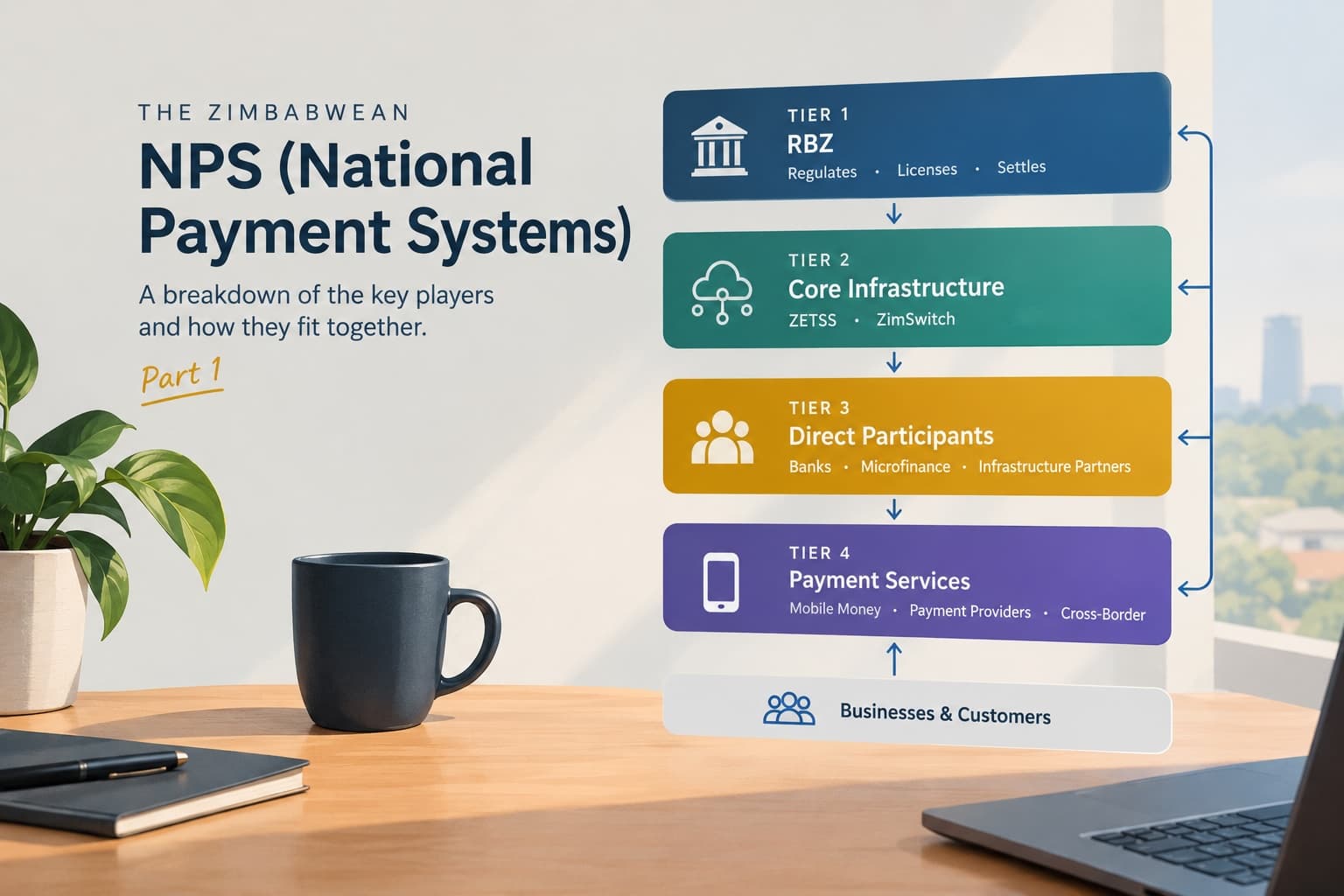
The payment systems infrastructure in Zimbabwe can sometimes feel like a maze to navigate. This post will break down the different components that make up the system as a whole and explain what they are.
Let’s start by defining it.
According to the RBZ website, the National Payment Systems (NPS) function was established in 1998 in response to the growing recognition among central banks of the need to pay closer attention to payment systems, given their significant contribution to financial stability and economic development. That’s corporate speak for: “We need to start regulating payment systems before things get out of hand.”
The NPS encompasses several organisations and systems that work together to ensure that people and businesses across the country can conduct different types of transactions efficiently.
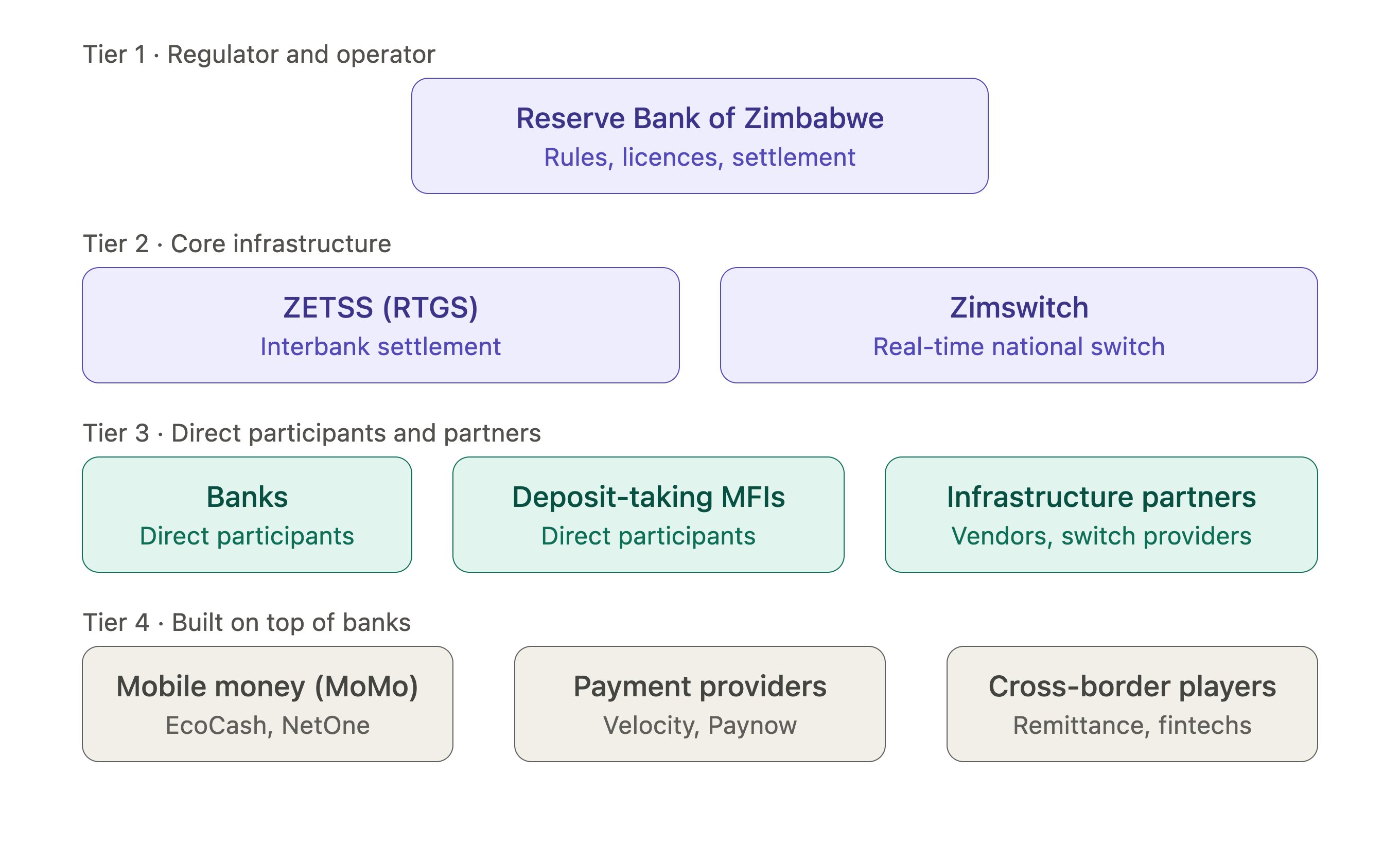
The various systems within the NPS, as well as some that sit on its periphery, can be broadly segmented into four tiers, based on the level of control each plays in the payments ecosystem and the potential impact if that component were to fail.
Tier 1
The RBZ
It writes the rules, licenses participants and operates the settlement systems, so nothing works without it.
It derives its powers to oversee, supervise and operate payment systems primarily from the Reserve Bank Act (Chapter 22:15) and the National Payment Systems Act (Chapter 24:23), also known as the NPS Act.
Tier 2
Core Infrastructure: ZETSS & ZimSwitch
ZETSS controls interbank payments, both locally and internationally. It operates what is known as the RTGS (Real-Time Gross Settlement) system, a system that allows one bank to transfer monetary value to another bank. At the end of the day, the RBZ calculates the difference between how much was sent and received by each bank and provides each bank with its deficit or surplus figure, which represents the amount it should pay or expect to receive, respectively.
It’s worth noting that the amount of value that a bank can move is limited by the amount of collateral funding it would have lodged with the RBZ when it first joined the NPS. RTGS transactions have one flaw. Most banks will tell you that transactions can take up to 48 hours to settle. Ironic for a system whose name includes the words “Real Time”. There has since been an improvement to the system called STP (Straight Through Processing), which allows for the automatic approval and receipt of transactions within certain limits. However, there is no standard or benchmark to adhere to, so it does not work uniformly across all participants.
ZimSwitch was, in a way, created to address this. ZimSwitch is what is known as the national transaction switch. Every country has one. It is responsible for connecting banks, mobile network operators, and fintechs onto one shared network. ZimSwitch does a lot, and I’ll cover all of its functions in another post. Effectively, however, it works in much the same way as RTGS, except that transactions happen in real time.
Each transaction on the ZimSwitch network performs a real-time lookup to determine whether the target account exists. If it doesn’t find anything, the transaction fails and is rejected immediately. This is where ZIPIT, ATM, and POS transactions are handled.
If any of these Tier 2 systems go down, most of the digital segments of the economy stop transacting.
Tier 3
Banks, Deposit-Taking Microfinance Institutions and Infrastructure Partners
These institutions are the direct participants in the Tier 2 layer. They are mainly regulated by the Banking Act (Chapter 24:20) of Zimbabwe, as well as other legislation relating to telecommunications, insurance and securities.
Most people know what banks and microfinance institutions do. There is, however, a lesser-known but very important role played by what I like to call infrastructure partners. These are institutions that banks rely on to offer services that sit on the periphery of a bank’s core business but are nonetheless necessary for the bank to keep operating. These include, but are not limited to, banking switch providers, POS machine vendors, ATM vendors, and software development companies.
The banking switch provider topic deserves its own post as well. A fun fact about software: most banks rely on third-party providers to develop their customer-facing platforms, such as internet banking and mobile apps, because software development is not considered a “core banking function”.
At one point in the past, almost the entire Zimbabwean banking industry, around 90%, relied on one organisation for their USSD and mobile banking applications.
Tier 4
MoMo (Mobile Money), Payment Providers and Cross-Border Players
These organisations carry a large share of everyday transactions, particularly mobile money transactions, but they sit on top of the banking and bank-switching infrastructure. MoMos were not always considered part of the NPS. However, in 2020, the Reserve Bank of Zimbabwe (RBZ) instructed all mobile money operators (MoMos) to integrate with ZimSwitch as the designated national payment switch under Statutory Instrument 80 of 2020.
That is why you can now send money from EcoCash to NetOne and vice versa. Those transactions go through ZimSwitch as the national switch. Payment providers are organisations such as Velocity, PayNow and Smile Cash.
You can find out more about how Velocity can solve your online payment needs here.
Payment providers and cross-border players usually provide services to niches within the economy that are not suitably served by higher-tier participants. This is where you find services such as payment gateways, remittance partners and other fintechs.
Up Next
In the next post, we’ll have a look at the types of transactions that are supported across the various tiers and why you can’t simply send a ZIPIT transaction to your South African bank account.